



Looking for industrial 3D printing solutions for serial production?
In the modern industrial landscape, the transition from traditional subtractive manufacturing to additive manufacturing is no longer a futuristic concept—it is a strategic necessity. While 3D printing was once viewed primarily as a tool for rapid prototyping, the technology has evolved into a high-precision method for functional serial production. For engineers and product designers, this shift represents a move toward greater design flexibility, reduced material waste, and localized supply chains. Achieving industrial-grade results, however, requires a deep understanding of material science and process control to ensure that every printed component meets rigorous mechanical standards.
Transitioning from Prototyping to Industrial Serial Production
The true value of additive manufacturing (AM) is realized when it moves beyond the R&D lab and onto the assembly line. Industrial serial production utilizing technologies such as Selective Laser Sintering (SLS) for polymers or Selective Laser Melting (SLM) for metals allows for the creation of end-use parts that match or exceed the durability of traditional components. Unlike hobbyist-grade methods, industrial 3D printing focuses on repeatability and traceable quality. This means every part in a series of hundreds or thousands remains consistent in its mechanical properties and dimensional accuracy.
By utilizing industrial-grade materials, companies can produce parts that withstand extreme temperatures, chemical exposure, and mechanical stress. The ability to manufacture small to medium batches cost-effectively bridges the gap between a single prototype and massive injection-molding runs, allowing for market testing and rapid iterations without the financial risk of expensive tooling.
Design for Additive Manufacturing (DfAM): Unlocking Complexity
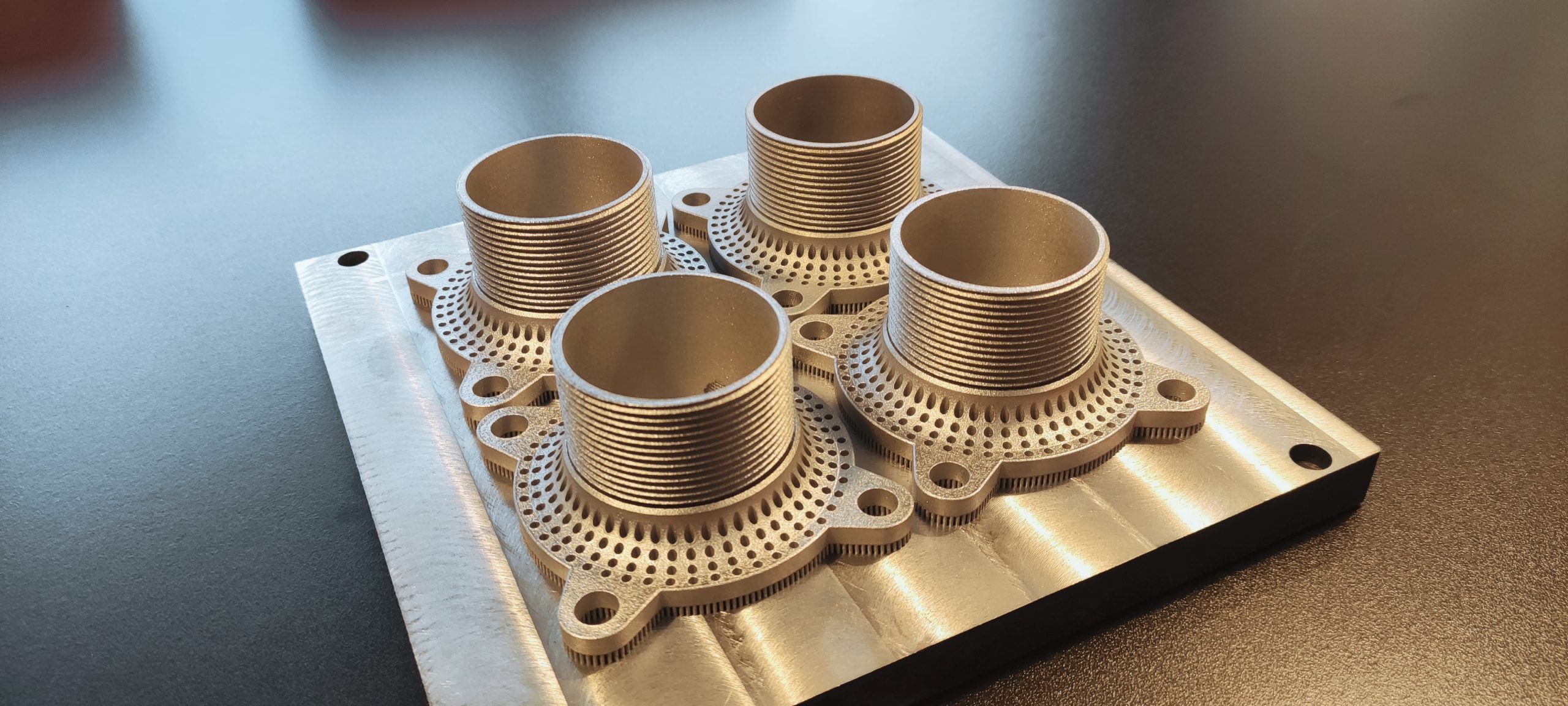
To fully leverage the benefits of 3D printing, components must be designed specifically for the process. This methodology, known as Design for Additive Manufacturing (DfAM), removes the constraints imposed by traditional CNC machining or molding. Complex internal geometries, lattice structures for weight reduction, and the consolidation of multiple parts into a single assembly are all possible. When a part is optimized for AM, it often performs better while using less material, directly contributing to both technical efficiency and sustainability.
Removing material where it isn’t needed to reduce weight without compromising strength.
Combining multi-part assemblies into one printed unit to eliminate assembly time and weak points.
Creating integrated cooling or fluid channels that are impossible to drill or cast.
According to research from leading European engineering institutes, DfAM can reduce the weight of aerospace or automotive components by up to 40% while maintaining the same structural integrity. This “Freedom of Design” is not just about aesthetics; it is about creating high-performance parts that were previously unmanufacturable. By integrating 3D printing early in the design phase, companies can optimize their products for the entire lifecycle, from manufacturing speed to end-use energy efficiency.
Selecting the Right Technology: SLS and SLM for Functional Excellence
The choice of technology determines the mechanical threshold of the final product. For high-strength, functional plastic components, Selective Laser Sintering (SLS) is the industrial standard. Because the process uses a powder bed to support the parts during the build, it allows for high-density nesting and the production of complex geometries without the need for support structures. This translates to lower labor costs during post-processing and greater freedom for interlocking parts.
When the application demands the properties of engineering-grade alloys, metal 3D printing via Selective Laser Melting (SLM) or Direct Metal Laser Sintering (DMLS) provides the solution. These processes create fully dense metal components from materials like stainless steel, aluminum, or titanium. These parts are not merely visual representations; they are structural components capable of handling high pressure, extreme thermal loads, and corrosive environments.
Material Performance Overview
For organizations focused on polymer production, plastic 3D printing offers a bridge to market that traditional manufacturing cannot match. Data from international manufacturing surveys indicates that companies utilizing AM for small-batch production can reduce their time-to-market by up to 60%, as they bypass the lengthy lead times required for mold fabrication and testing.
Post-Processing: Ensuring Industrial Grade Finishes
A 3D-printed part is often only as good as its finish. For end-use applications, post-processing is a critical stage that ensures the part meets aesthetic and environmental requirements. Techniques such as chemical vapor smoothing or vibratory finishing reduce surface roughness, which is essential for parts that must be easy to clean or have specific aerodynamic properties.
Provides consistent deep-black or custom colors that permeate the surface for long-term wear resistance.
Mechanical or chemical smoothing to achieve the tactile feel and friction levels required for moving assemblies.
Furthermore, industrial quality is maintained through rigorous inspection and traceability. By utilizing 3D scanning and reverse engineering, manufacturers can verify that the printed parts align perfectly with the original CAD data. This digital-to-physical verification is a prerequisite for highly regulated sectors like medical technology and aviation, where dimensional precision is a matter of safety and compliance.
As global supply chains become more volatile, the ability to manufacture parts locally and on-demand becomes a significant competitive advantage. Industrial additive manufacturing enables a “digital warehouse” model, where parts are stored as files and produced only when needed. This approach eliminates the waste of overproduction and ensures that even legacy machinery can be maintained with custom-printed spare parts. By integrating these advanced manufacturing solutions, businesses can ensure their production lines remain resilient, cost-effective, and ready for the demands of tomorrow.
Ready to optimize your industrial production?
Our engineering team at Materflow Oy is ready to help you transition to serial additive manufacturing. From DfAM optimization to high-precision metal and plastic production, we provide the technical expertise your project demands.