




Polyamide & Industrial Plastics: Quality Assurance in Additive Manufacturing
Industrial manufacturing is currently witnessing a fundamental shift as Additive Manufacturing (AM) moves beyond the experimental phase into the core of serial production. For engineers and product designers, the transition from traditional injection molding to 3D plastic printing is not merely a change in machinery, but a strategic move toward greater design flexibility and supply chain resilience. High-performance polymers, particularly Polyamide 12, have become the backbone of this movement, offering a combination of mechanical durability and chemical resistance that rivals conventional manufacturing methods.
Achieving industrial-grade results requires more than just a printer; it demands a rigorous approach to quality assurance and a deep understanding of material behavior during the fusion process. When parts are destined for functional use in aerospace, medical technology, or heavy machinery, the margin for error disappears. Understanding how industrial plastics behave under thermal stress and how process parameters influence the final microstructure is essential for any organization looking to scale their production through additive technologies.
The Industrial Standard: Polyamide 12 (PA 2200) in 3D Plastic Printing
Polyamide 12, often referred to by its commercial name PA 2200, stands as the most versatile material in the realm of industrial 3D plastic printing. Its popularity is rooted in its balanced property profile, which allows it to withstand significant mechanical stress while maintaining dimensional stability. Unlike hobbyist-grade materials that may degrade or warp, PA 2200 produces parts with high detail resolution and excellent long-term performance.
Material Properties: PA 2200 (White)
Why this matters: These specifications mean that parts printed with PA 2200 can safely replace many traditionally manufactured components. The high melting point ensures the part remains rigid even in warm environments, while the tensile strength means it can endure pulling and pressure without snapping or deforming permanently.
Beyond strength, Polyamide 12 is biocompatible according to USP Class VI standards, making it a safe choice for medical devices and components that come into contact with skin. For industrial applications, its resistance to most chemicals, oils, and fuels is a critical advantage, ensuring that parts remain functional in harsh environments where other plastics would eventually fail or swell.
Precision Through Selective Laser Sintering (SLS)
The method used to process these industrial plastics is just as important as the material itself. Selective Laser Sintering (SLS) is the preferred technology for serial production. In this process, a high-powered laser fuses small particles of plastic powder layer by layer. The beauty of this technique lies in its “self-supporting” nature; the unsintered powder surrounding the part acts as a natural support structure.
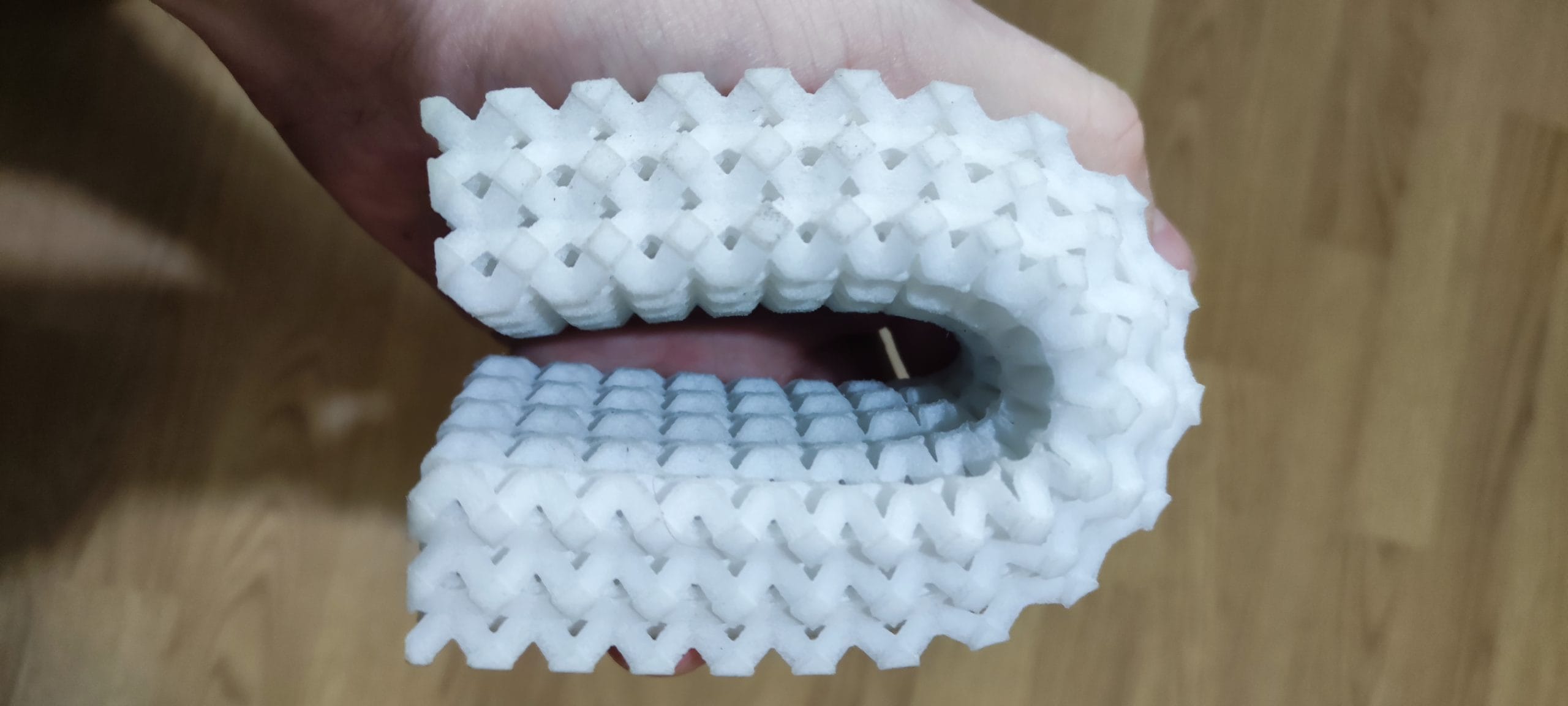
Because no physical support structures are needed, engineers can design complex internal channels and lattices. This allows for lighter parts that maintain high structural integrity.
Parts can be stacked in the build volume in all three dimensions. This “nesting” capability maximizes output per print run, making small-to-medium series production cost-effective.
From a quality assurance perspective, SLS provides isotropic mechanical properties, meaning the part is nearly as strong in the Z-axis (vertical) as it is in the X and Y axes. This consistency is vital for functional components, as it eliminates the weak points often found in lower-end 3D printing methods. In a serial production environment, this translates to predictable part behavior and a significantly lower rejection rate during inspection.
Strategic Value Through Design for Additive Manufacturing (DfAM)
The true economic advantage of 3D plastic printing is realized when the part is designed specifically for the process. Traditional manufacturing often forces engineers to compromise, adding material where it isn’t needed simply to satisfy the requirements of a mold or a milling tool. DfAM flips this logic, allowing for “topology optimization” where material is placed only where stress dictates.
Merging multiple components into a single printed part. This eliminates assembly labor and reduces the risk of joint failure, resulting in a more reliable end product.
Using lattice structures to reduce weight without sacrificing stiffness. In industries like aerospace or robotics, every gram saved improves energy efficiency and performance.
Industrial Post-Processing: Achieving End-Use Quality
For a part to move from the printer to a functional assembly, it must meet specific surface requirements. In industrial applications, the “raw” finish of a sintered part is often just the starting point. Depending on the environment—whether it is a medical cleanroom or an exposed heavy machinery component—different finishing techniques are applied to enhance both aesthetics and performance.
Chemical Smoothing & Dyeing: This process seals the surface of the plastic, making it resistant to moisture and easier to clean. For consumer-facing parts or industrial interfaces, dyeing allows for deep, scratch-resistant colors that do not peel or flake like traditional paint. This ensures the part maintains its professional appearance even under heavy mechanical wear.
Quality Assurance and Material Traceability
Transitioning to serial production requires a partner who treats additive manufacturing as a controlled industrial process rather than a prototyping service. The reliability of PA 2200 material is maintained through strict powder management and climate-controlled build environments. According to industry-wide manufacturing standards, consistency in the thermal cycle is what determines the repeatable accuracy of the final batch.
Full material traceability ensures that every component can be traced back to its specific production lot and raw material batch. This level of oversight is mandatory in sectors where safety and failure analysis are paramount. By combining certified materials with validated processes, companies can confidently integrate 3D printed components into their most demanding systems, knowing that each part meets the required technical specifications.
Industrial 3D plastic printing has matured into a reliable, cost-effective alternative to traditional manufacturing. By leveraging materials like Polyamide 12 and optimizing designs for the SLS process, manufacturers can reduce lead times, eliminate tooling costs, and produce high-performance parts that meet the rigorous standards of modern industry.
Ready to optimize your production?
Our experts are ready to help you navigate the transition from prototyping to industrial serial production.